Co-speech gesture generation has made substantial progress in motion quality and speech--motion synchronization, yet existing methods largely focus on direct speech-to-motion mapping or position-wise semantic relevance, leaving the temporal evolution of semantically relevant gestures over upcoming intervals underexplored. We propose PlanTalk, a hierarchical speech-to-plan-to-motion framework that introduces discrete motion plans to organize short-horizon body-motion evolution. During pretraining, a future motion-plan tokenizer learns to encode and reconstruct temporally ordered windows of subsequent body-motion tokens, excluding the current token. The resulting discrete representations serve as motion plans that summarize upcoming motion evolution rather than a single future state. A speech-to-plan predictor learns to infer these plans from speech-semantic features without accessing future motion at inference. The predicted plans guide body-motion generation through two complementary mechanisms: an event-aware semantic gate refines when semantically relevant motion is activated, while hierarchical plan-conditioned feature-wise linear modulation (FiLM) modulates how the plan is realized across shared body, body-part, and motion-token representations. Experiments on BEAT2 demonstrate improvements in motion quality, speech--motion synchronization, diversity, and semantic relevance. Zero-shot evaluation on SHOW further demonstrates the cross-dataset generalization of the proposed framework.
Method
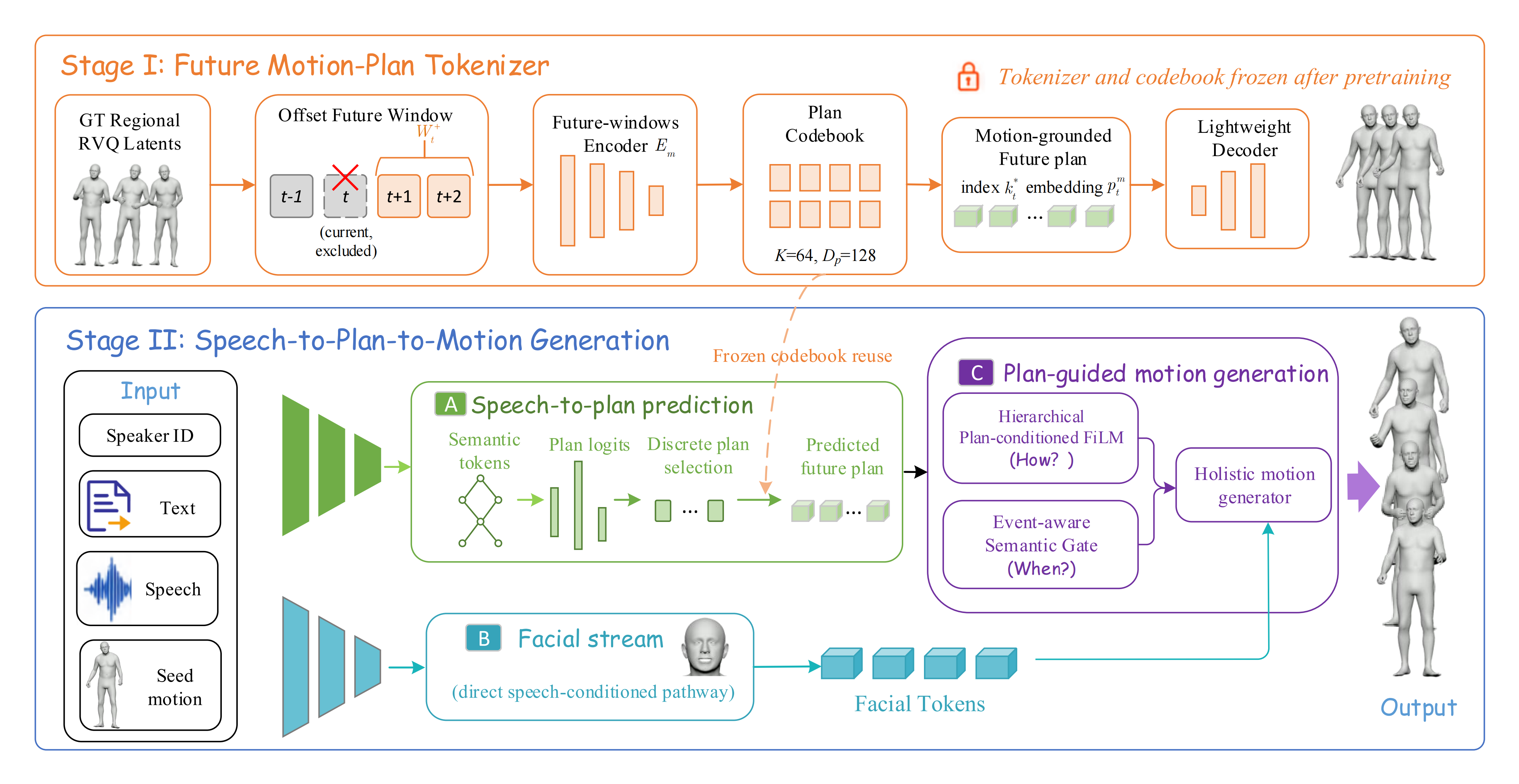
Overview of PlanTalk. Stage I learns a motion-grounded discrete future-plan vocabulary from offset future body-motion windows and freezes the pretrained tokenizer and codebook. In Stage II, a speech-to-plan predictor infers discrete plans from speech-semantic features using the frozen codebook, while the facial stream remains directly speech-conditioned. The predicted plans guide body-motion generation through an event-aware semantic gate for when semantic motion is activated and hierarchical plan-conditioned FiLM for how the planned motion is realized. Future motion is required only for plan supervision during training, not at inference.